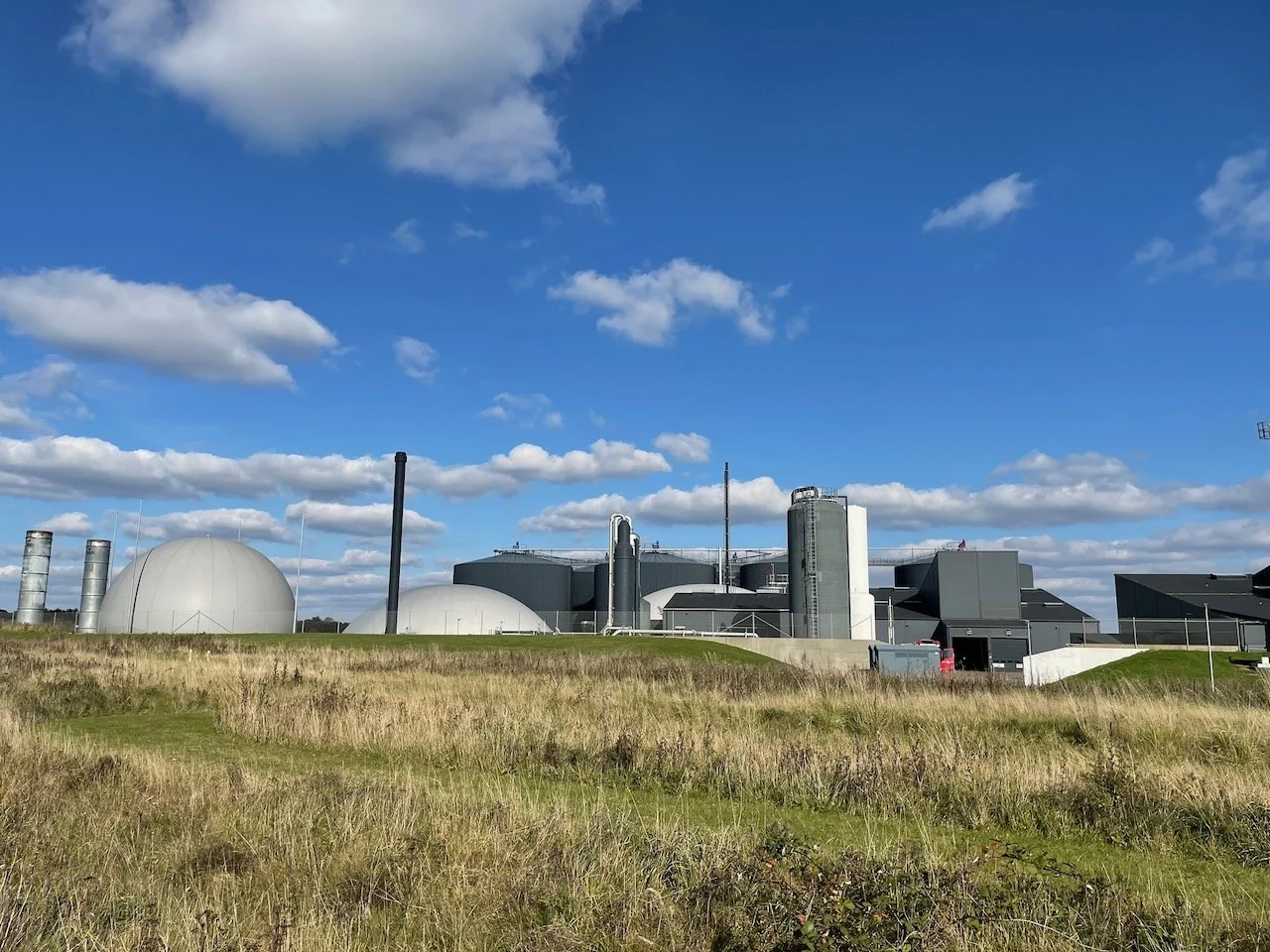
Turning Venting into Value.
From Waste - to Revenue Stream
Most biogas plants already separate high-purity biogenic CO₂ as part of biomethane upgrading. Today, this CO₂ is typically vented to the atmosphere — even though it is one of the easiest and lowest-cost CO₂ streams to capture.
With Carbon Capture, Utilisation and Storage (CCUS) and DecarbonICE, this changes.
Why CCUS for Biogas?
By capturing and permanently storing biogenic CO₂, biogas plants can:
Generate carbon removal credits (BECCS)
Access EU ETS and national CCS schemes
Sell removals into voluntary carbon markets
Create a new revenue stream independent of gas prices
Most biogas plants can transform their CO₂ stream into a strong, recurring income opportunity.

Why biogas is perfect for CCUS
Biogas plants are uniquely positioned for cost-efficient carbon removal:
High CO₂ Concentration
The CO₂ is already separated from methane and relatively pure.
Existing Value Chain
Methane upgrading is already paid for through biomethane sales.
Stable Volumes
Medium-sized plants typically generate ~13,000 tons CO₂/year with limited seasonal variation.
Political Tailwinds
EU ETS is expected to include BECCS from ~2028, and national carbon removal schemes are emerging.
Premium Carbon Removals
Biogenic CO₂ stored permanently qualifies as carbon removal — often priced higher than avoided emissions.

How it works
CO₂ is purified and liquefied at the biogas plant
Liquid CO₂ is converted into dry ice
Dry ice is loaded directly into DecarbonICE containers
Containers are transported by truck (two per vehicle)
At the hub, dry ice is reliquefied for storage or utilisation
All modules are containerised and easy to integrate at existing biogas sites.
38% lower transport cost using DecarbonICE
The longer the distance, the larger the advantage
The Challenge: Transport & Infrastructure
Capturing CO₂ is only part of the equation.
Biogas plants are typically:
Small to medium scale
Geographically dispersed
Not connected to pipelines
Far from storage hubs
Traditional liquid CO₂ transport in pressurised ISO tanks is:
Capital intensive
Logistically complex
Limited to one tank per truck
Expensive at small scale 
This is where DecarbonICE changes the economics.
The DecarbonICE Solution
Modular, Safe & Scalable CO₂ Infrastructure
DecarbonICE converts liquid CO₂ into solid CO₂ (dry ice) and transports it in insulated 20-foot containers at near atmospheric pressure
What’s in it for Biogas Operators?
Higher Net Carbon Margin
1
Lower transport cost means more of the ETS / credit price stays with the biogas plant.
Low CAPEX Entry
2
Solid CO₂ containers cost ~10,000 € per unit vs. 120,000 € for liquid ISO tanks. Lower upfront investment = faster decision making.
Two Containers per Truck
3
Weight optimisation allows two DecarbonICE containers per truck, doubling logistics efficiency
Safer Operation
4
Transport at near atmospheric pressure improves safety compared to high-pressure liquid tanks
Fully Modular & Intermodal
5
Truck, train, barge or ship — designed for flexible scaling.